
The audience inside the Ed Sullivan Theater expected another chaotic night of political comedy.
What they got instead was one of the most talked-about late-night television moments of the year — a brutal, slow-burning confrontation that left social media exploding, cable news scrambling for clips, and supporters of Donald Trump furious long after the cameras stopped rolling.
At the center of the storm stood Stephen Colbert, who transformed what began as a routine monologue into a devastating prime-time spectacle after Trump once again boasted publicly about having a “180 IQ.”
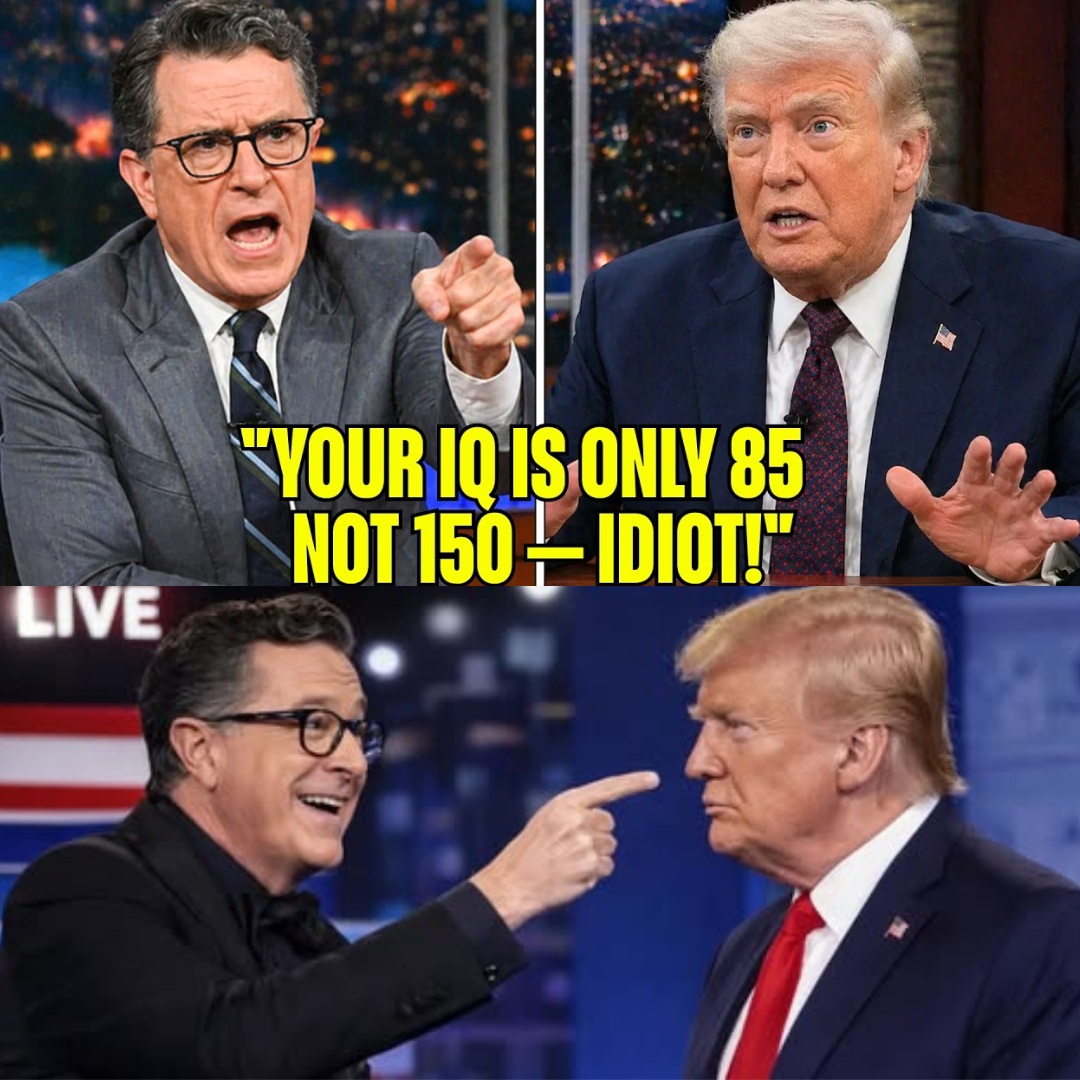
The claim spread rapidly earlier that day during a campaign-style appearance where Trump praised his own intelligence while attacking political rivals, journalists, prosecutors, and television personalities.
“I have one of the highest IQs anywhere in Washington,” Trump declared during the event. “Probably 180. Maybe higher. People are always amazed.”
Supporters cheered wildly.
Critics immediately mocked the statement online.
But nobody expected Colbert to turn the boast into a national media firestorm only hours later.
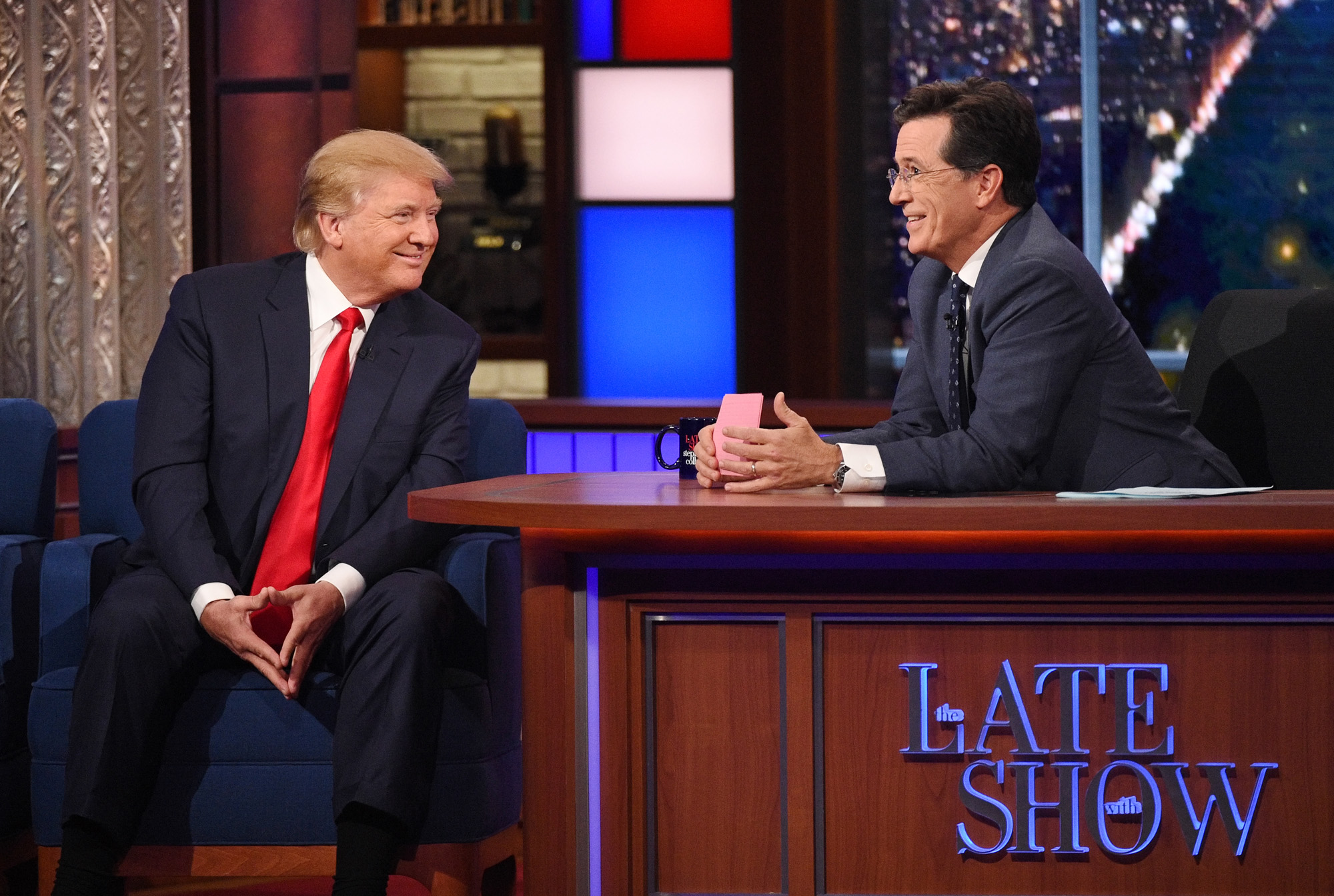
When the cameras rolled for that night’s broadcast, the late-night host walked onto the stage smiling calmly while the crowd erupted into applause. At first, viewers expected the usual barrage of sarcastic one-liners aimed at the former president.
Instead, Colbert took a different approach.
And that made the moment far more devastating.
“Today,” Colbert began casually, “Donald Trump announced he may have a 180 IQ.”
The audience laughed instantly.
But Colbert didn’t rush toward the punchline.
Instead, he paused, adjusted his papers, and looked directly into the camera with almost theatrical seriousness.
“Now, I’m not saying he’s wrong,” he said slowly. “I’m just saying that if someone actually had a 180 IQ… they probably wouldn’t spend half their day explaining it.”
The audience exploded.
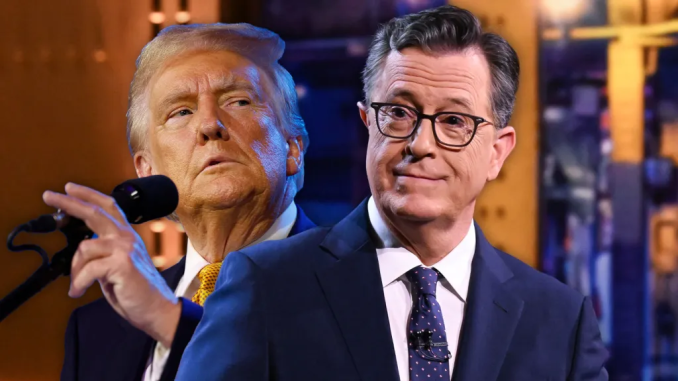
The laughter rolled through the theater for several seconds before Colbert continued.
What followed became television gold.
Rather than screaming, ranting, or mocking Trump aggressively, Colbert dismantled the claim piece by piece with cold, almost clinical humor. He pulled up archived clips of Trump contradicting himself during speeches, mixing up names at rallies, and making bizarre public statements that had already circulated online for years.
The crowd roared louder with every clip.
One montage showed Trump struggling through confusing explanations about magnets, water pressure, and military technology during past campaign events. Another highlighted moments where the former president appeared to lose track of sentences midway through speeches.
Then Colbert delivered the line that instantly detonated across social media.
“You know,” he said calmly, “most geniuses don’t need Sharpies to redraw hurricanes.”
The studio audience lost control.
People stood up laughing.
Some viewers could be seen wiping tears from their eyes as the applause drowned out the show entirely for several moments.
Within minutes, clips from the segment exploded online.
TikTok flooded with reposts.
X turned into a battlefield.
YouTube reaction channels uploaded emergency commentary videos before the broadcast had even finished airing on the West Coast.
The hashtag “180IQ” began trending nationwide almost immediately.
But the real damage came from Colbert’s tone.
He never appeared angry.
He never raised his voice.
That calmness made the takedown feel even sharper.
Political analysts later noted that Colbert’s approach created the impression not of outrage, but disbelief — as though Trump’s claim collapsed under the weight of simple public memory alone.
And viewers noticed.
One viral comment receiving millions of views read:
“Colbert didn’t roast him. He autopsied him.”
Trump supporters, however, reacted with fury.
Conservative influencers accused Colbert of elitism and media bullying. Several pro-Trump personalities argued the segment represented another example of Hollywood comedians attacking conservatives under the disguise of entertainment.
Others claimed the late-night host had selectively edited clips unfairly to embarrass Trump publicly.
The backlash intensified overnight.
Right-wing commentators demanded apologies.
Some called for boycotts.
Others accused mainstream television networks of obsessively targeting Trump because they feared his continued political influence.
Yet the controversy only made the clips spread faster.
By morning, nearly every major news network was discussing the segment.
Cable television panels replayed Colbert’s jokes repeatedly while debating whether late-night comedy had become too politically aggressive. Media experts argued over whether Trump’s own provocative style invited such ridicule — or whether entertainers had crossed a line into outright political activism.
Meanwhile, Colbert’s ratings reportedly surged.
Viewers who rarely watched late-night television suddenly tuned in specifically to see the now-infamous monologue everyone online was discussing.

And then came the escalation.
The next day, Trump reportedly reacted privately with anger after advisers informed him the segment had gone massively viral. According to insiders close to his political orbit, the former president complained bitterly about television hosts, media “smears,” and what he viewed as coordinated humiliation campaigns against him.
“He hates when comedians make the clips stick,” one source reportedly explained. “Because people remember jokes more than policy speeches.”
That fear proved justified.
The “180 IQ” line rapidly transformed into internet shorthand for exaggerated political ego. Memes flooded social media showing fake report cards, parody genius certificates, and edited images portraying Trump surrounded by calculators, science equations, and children’s puzzles.
Even rival comedians joined the frenzy.
Late-night hosts across multiple networks referenced the controversy during their own monologues. Some mocked Trump directly. Others jokingly pretended to take online IQ tests live on-air.
But Colbert remained at the center of the storm.
Entertainment outlets praised the segment as one of his sharpest political takedowns in years. Several commentators argued the monologue succeeded because it avoided screaming outrage and instead relied on timing, restraint, and visual contrast between Trump’s self-praise and publicly available footage.
The simplicity made it devastating.
“You can’t really argue with video,” one media columnist wrote.
Trump allies attempted counterattacks.
Some supporters circulated clips of Trump discussing economic growth, foreign policy, and business deals as evidence of intelligence and strategic skill. Others argued IQ itself was meaningless compared to political instinct and charisma.
But the internet had already chosen its narrative.
And the narrative was brutal.
For days, the controversy dominated online culture.
College students quoted Colbert’s lines in viral videos.
Political commentators referenced the segment during interviews.
Even sports radio hosts joked about the “180 IQ” claim between discussions of playoff games and draft rumors.
The story escaped politics entirely and entered entertainment mythology.
Inside CBS, executives reportedly recognized immediately that the moment had become a cultural phenomenon. Clips from the monologue generated enormous engagement numbers across digital platforms, with younger audiences especially drawn to Colbert’s calm, almost surgical delivery.
That style contrasted sharply with Trump’s famously aggressive public persona.
And that contrast fascinated viewers.
Some analysts argued the segment reflected a broader shift in how political satire functions in modern America. Instead of traditional comedy built around punchlines alone, audiences increasingly responded to moments that felt emotionally authentic — moments where humor blurred into public accountability.
Others warned that entertainment and politics had become so intertwined that comedy shows now operated almost like unofficial campaign battlegrounds.
Whatever the explanation, one fact remained undeniable:
The segment had landed hard.
Yet perhaps the most revealing reaction came not from politicians or comedians, but from ordinary viewers online.
Across social media, users repeatedly focused on Colbert’s composure. He did not appear enraged. He did not rant. He simply let Trump’s own words collide against years of public footage while maintaining an expression somewhere between amusement and disbelief.
That restraint made the spectacle feel less like a partisan attack and more like cultural humiliation.
And humiliation spreads faster online than almost anything else.
By the weekend, political podcasts were still dissecting the confrontation.
Some argued Trump’s boast had been obvious hyperbole never meant to be taken literally. Others insisted the former president’s obsession with projecting dominance and superiority made him uniquely vulnerable to ridicule whenever those claims collapsed publicly.
One commentator summarized the situation bluntly:
“Trump built a political brand around being stronger, smarter, richer, and tougher than everyone else. So when somebody punctures that image effectively, people react like they’re watching a heavyweight champion stumble.”
That stumble had now been replayed millions of times.
Meanwhile, Colbert leaned further into the controversy during follow-up episodes. Rather than retreating from the backlash, he joked casually about suddenly becoming “America’s leading IQ researcher.”
The audience erupted again.
Each new joke reignited the online war.
Trump supporters accused Hollywood of obsession.
Colbert fans celebrated the comedian as fearless.
And somewhere between politics, entertainment, and spectacle, the entire country once again found itself consumed by another bizarre chapter in America’s endless media circus.
Because in modern America, television is no longer simply entertainment.
It is combat.
Every monologue becomes ammunition.
Every viral clip becomes political currency.
And every public boast risks becoming tomorrow night’s punchline under the bright lights of live TV.